Signs a Tree Near Your House Should Come Down
A tree rarely announces the day it turns from shade into risk, but it usually leaves clues you can see from the lawn.
October 13, 2026 · 4 min read
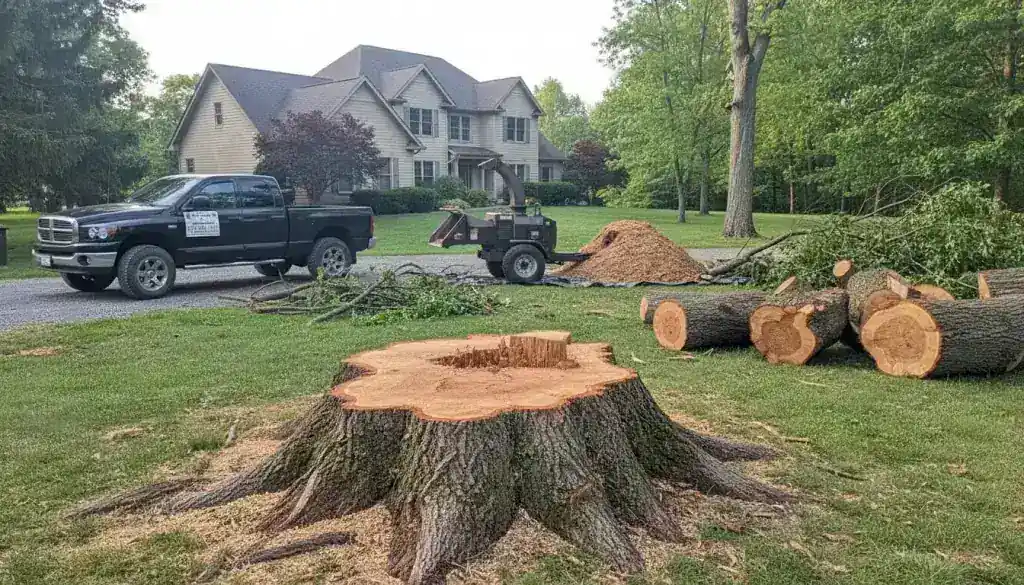
Most trees beside a house are a good thing. They shade the yard, keep the upstairs cooler in July, and make a street in Enola or Camp Hill feel settled and established. The trouble is that a tree rarely announces when it has gone from asset to hazard. The change happens slowly, and then one windy night it happens all at once. This guide covers the signs worth taking seriously, so you can call for an estimate on your own schedule instead of letting a storm set the schedule for you.
Dead or dying wood
Start with the crown, the leafy top of the tree. In summer a healthy tree is leafed out fairly evenly. If one side stays bare while the neighbors are green, if big sections of branches never produced leaves, or if the twigs snap dry instead of bending, that wood is dead. Dead branches are brittle and they drop without warning. A tree that is mostly dead is mostly deadfall waiting for its moment.
Then look at the trunk. Bark peeling away in sheets, deep vertical cracks, mushrooms or shelf-like growths near the base, and crumbly debris around the roots all suggest the inside of the tree is breaking down. Any one of these can have a harmless explanation. Several together on a large tree beside a house are a reason to get a professional to look.
A lean that is new
Plenty of trees lean, and many have leaned their whole lives, growing toward light. A lean that has always been there, with the trunk curving to correct itself, is usually less worrying than a lean that is new. Look at the ground. Fresh cracks in the soil on the side opposite the lean, a small mound of raised earth near the base, or roots that have lifted out of the ground mean the root system may be shifting. After a long wet stretch or a hard storm, take a walk around any tree that looks different than it did last month.
Direction matters too. A tree tipping away from your house gives you more margin than one tipping toward the roof, the garage, or the driveway where the cars sit.
Hollow trunks and old wounds
A hollow tree is not automatically doomed. Some trees live for decades with a cavity. What counts is how much sound wood is left around the hollow, because a thin wall has less strength to stand up to wind. Look for cavities, large wounds that never closed over, old cuts where limbs were removed badly, and places where two main stems join in a tight V with a crack running between them. Those tight joints are a common place for a big tree to split.
Limbs over the roof
Branches that reach over a house deserve their own category, because the roof is exactly where a falling limb does the most damage. Watch for these:
- Branches that touch or scrape the shingles when the wind picks up
- Limbs hanging over the roof, the chimney, or a bedroom wall
- Long, heavy branches that reach straight out sideways with little taper
- Dead stubs high in the crown directly above the house
Not every overhanging limb means the whole tree has to go. Often trimming takes off the hazardous limbs, protects the roof, and leaves the tree standing. K&K does tree trimming for exactly this reason, removing hazardous limbs over structures. When the problem is the tree itself rather than a few branches, removal is the cleaner answer, and it is worth saying so plainly instead of trimming a tree that will only be a worry again next year.
Problems that start underground
Roots do not announce themselves, but the ground gives hints. If a trench was dug near a tree for a new line, if the grade changed because of a patio or driveway, or if a heavy machine spent weeks parked on the root zone, the tree may be weaker than it looks. Roots lifting a walkway or pushing against a foundation wall are also worth noting. A tree can look fine for a year or two after root damage and then fail in the first strong wind.
If you are not sure whether what you are seeing is serious, you are in good company. Plenty of K&K customers start with a tree they have worried about for a season. One of them, Jason H., put it this way: "K & K did a great job! They responded quickly and had our giant old dying tree down and out of harms way that week."
What to do when you spot one of these signs
Stay on the ground. Climbing or cutting a tree near a house is how a bad situation turns into an injury, and a dead tree can break in ways that surprise even experienced people. Instead, take a few photos from different angles: the whole tree, the trunk base, and any limb that worries you, with the house in frame so the distance is clear. Make a note of when you first noticed the sign and whether it has changed.
K&K Properties & Services Inc. is based in Enola and works within about 20 miles of Harrisburg, including Camp Hill. John has more than 30 years of construction and property maintenance experience, and estimates are free. Call or text (717) 884-2572 with your photos and a short description, and you will get a straight answer about whether the tree can stay, needs trimming, or needs to come down. If a tree is down or about to be, call directly, because emergency response is available around the clock.
K&K Properties & Services Inc., (717) 884-2572
Call (717) 884-2572More articles
Stump Grinding or Leaving the Stump: What Actually Happens
After the tree is gone, the stump is the part people put off, and it is worth knowing what each choice really means for your yard.
What to Do When a Tree or Limb Comes Down on Your House
The first hour after a tree hits the house is mostly about safety, so here is a calm order of operations.